
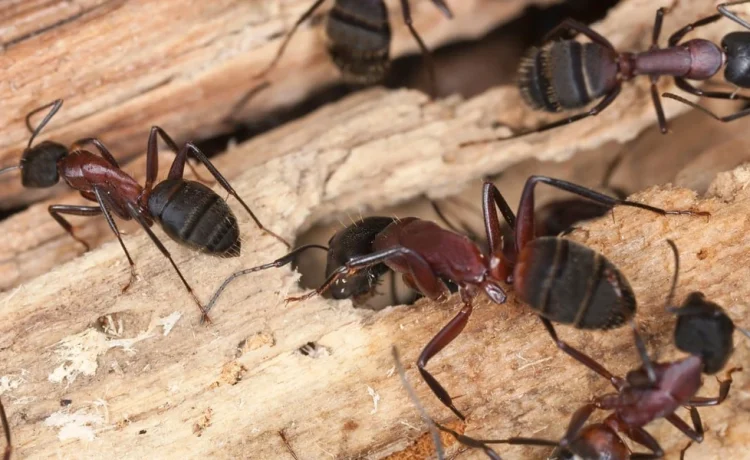
A few large black ants inside the house are easy to dismiss. In a Clermont home, though, they deserve a closer look. Carpenter ants are selective about where they build nests, and the location they choose often reveals something about the property. Unlike termites, they do not feed on wood. They excavate it and prefer areas where leaks, humidity, or long-term moisture have already weakened the material. With Clermont receiving around fifty inches of rain each year and enduring months of summer humidity, homes have plenty of opportunities for hidden damp areas to develop. When these ants appear, Avata Pest Control in Clermont starts by looking for what made the wood attractive in the first place.
How Carpenter Ants Use Wood Inside a Home
Many homeowners assume carpenter ants damage wood by eating through it. Their behavior is different from termites. Carpenter ants remove pieces of wood to create tunnels and nesting chambers, pushing the debris out as they expand their galleries. The result is often a smooth, hollowed-out passage inside the material.
The wood itself is not their food source. Carpenter ants typically feed on insects, sugary substances such as honeydew produced by other insects, and food particles they find around a home. They choose wood because it provides a protected place for the colony to live.
Why Moisture-Damaged Wood Attracts Them
Dry, solid lumber is difficult for carpenter ants to excavate. Wood softened by a plumbing leak, roof issue, condensation, or prolonged exposure to humidity is much easier to tunnel through. That is why these ants often appear around areas where moisture has been present for some time.
The damp spots that draw them are the ones you’d expect. A slow leak under a sink or behind the dishwasher softens the wood around it without anyone noticing. Worn seals around windows and doors let rain and condensation work in. Up top, a clogged gutter or a small roof leak keeps the soffits and framing damp. Outside, decks, porch posts, and steps stay wet where they meet the ground and never fully dry out. Once carpenter ants establish a nest in softened material, they may continue into nearby sections of stronger wood. A small moisture issue can eventually weaken wood over a wider area if the source is left unresolved.
What Carpenter Ants Reveal About a Clermont Home
Carpenter ants indoors are often a sign that moisture has been present somewhere nearby. The ants did not create the damp conditions; they found an area where those conditions already existed.
That makes the water source just as important as the colony itself. A slow leak behind a wall, poor drainage near the foundation, or moisture trapped around exterior wood can continue creating favorable nesting conditions even after visible ants are removed.
Florida’s carpenter ants are among the larger ant species in the state, and an established colony often spreads across more than one nest. A main colony may live outdoors in a tree or stump, while satellite nests form inside a house wherever the conditions suit them. That is part of why treating the ants on the counter rarely settles the problem on its own.
Clermont’s environment can make these situations easier to develop. Summer storms from June through September bring frequent rainfall, while heavy humidity and tree cover can slow evaporation around shaded areas of a property. Over time, those conditions can leave small sections of wood vulnerable to carpenter ant activity.
Why Effective Treatment Starts With an Inspection
Getting rid of them for good comes down to finding the water that drew them in. That’s how Avata handles carpenter ants in Clermont, working through a few things on each visit:
- Follow the ant trails back to the nests, not just the workers walking across the counter.
- Check the spots where water collects, leaks, poor drainage, and corners that never get much airflow.
- Treat the nests themselves, so the problem gets cut off at the source instead of thinned out on the surface.
- Look for more than one nest, since a big colony can spread across a few parts of a property.
The ants usually disappear once the wood dries and the nests are gone.