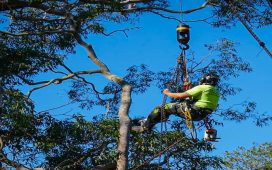

Most Gold Coast homeowners think about their trees twice a year. Once when the council sends a reminder about vegetation management near powerlines, and once after a storm when a branch has gone through something it should not have. The window between those two moments is where nearly every serious tree failure originates – in the gradual development of included bark at a branch union, in the slow decay behind a wound that was never properly treated, in the canopy weight that accumulated across a wet season without anyone noticing. Tree trimming in Gold Coast is not a cosmetic exercise. It is risk management conducted in a climate that is generous to tree growth and entirely unforgiving during storm events.
Why Gold Coast Trees Grow Differently
The subtropical growing conditions on the Gold Coast accelerate canopy development in a way that property owners moving from cooler climates consistently underestimate. A tree that seemed manageable at the start of the wet season can close over a powerline clearance zone, develop significant new structural weight, and produce large quantities of deadwood before the following dry season. Species like camphor laurel, poinciana, and jacaranda – common in established Gold Coast suburbs – respond to the combination of heat, humidity, and rainfall by producing rapid lateral growth that changes the risk profile of the tree significantly faster than equivalent species in southern Australian climates.
What Included Bark Actually Means
Most homeowners are told a branch has included bark and nod without fully understanding why it matters. Included bark forms when two co-dominant stems grow upward together, and the bark between them gets folded inward rather than forming a strong collar weld. The result is a union held together by surface contact rather than interlocking wood fibres. Under wind loading – the kind of loading the Gold Coast experiences regularly during storm season – those unions fail in a way that sound branch attachments do not. The failure is not gradual. It is sudden, complete, and frequently involves the entire co-dominant stem rather than just the branch tip.
When Trimming Makes a Tree More Dangerous
This is the counterintuitive reality that separates qualified arborists from general garden maintenance operators. Removing too much canopy from certain tree species triggers vigorous epicormic regrowth – dense clusters of weakly attached shoots that sprout from the cambium layer in response to stress. Those shoots grow rapidly, develop significant weight quickly, and attach to the parent stem with a weaker mechanical bond than the primary branch structure. A tree that was trimmed aggressively and then left for a season can present a substantially higher failure risk than it did before trimming. Tree trimming in Gold Coast conducted without an understanding of species-specific regrowth behaviour can create exactly the problem it was intended to prevent.
How Powerline Proximity Changes What Is Possible
Trees growing within the Energex exclusion zones around Gold Coast powerlines are subject to clearance requirements that determine how and whether pruning can proceed. Work within certain distances of energised conductors must be performed by line-clearance qualified arborists using specific equipment and safe work procedures. Property owners who engage general tree services for powerline proximity work – or who attempt to manage vegetation near lines independently – create liability exposure that extends well beyond the property boundary. The regulatory framework exists because contact with energised lines during vegetation work is not a recoverable error.
Why Storm Season Timing Matters for Trimming
There is a window for structural pruning work that most Gold Coast homeowners miss because the trigger for thinking about trees is the storm itself, rather than the preparation for it. Pruning conducted well before the storm season allows wound wood to develop before the tree faces its highest stress period. Tree trimming done immediately before or during the storm season removes protective canopy mass without allowing recovery time and, on certain species, stimulates the rapid flush regrowth that arrives just as wind events become more frequent.
Conclusion
Tree trimming in Gold Coast is most effective when it is understood as a structural and safety exercise rather than a maintenance routine. The region’s climate, its common species, its powerline infrastructure, and its storm season all create conditions where timing, technique, and species knowledge determine whether trimming reduces risk or inadvertently increases it. Property owners who engage qualified arborists with genuine Gold Coast experience consistently manage their trees, achieving better outcomes in every subsequent storm season.